
Proper grading plays an important role in preparing land for construction, landscaping, drainage improvements, and other property projects. The slope and elevation of a site can affect how water moves across the property, how stable the ground remains, and how well new structures perform. Because these factors are not always obvious from the surface, professional site evaluations are essential before significant work begins. Understanding how professionals assess a property can help owners recognize why grading requires careful planning rather than simply moving soil from one location to another.
Evaluating Existing Site Conditions
Professional site grading services begin by examining the property’s existing conditions. This assessment typically considers the site’s overall topography, current slopes, elevation changes, soil conditions, vegetation, structures, driveways, and other physical features.
Professionals need to understand how the property currently functions before determining what changes may be necessary. Even relatively small elevation differences can influence drainage patterns and affect how water moves toward buildings or neighboring areas.
Surveying and measuring the property can provide a more precise understanding of its contours. Depending on the project, professionals may use surveying equipment, grading plans, elevation data, and other information to identify high and low points throughout the site. These measurements help establish whether the existing terrain can support the intended improvements or whether substantial earthwork will be required.
Drainage is another important consideration during the initial evaluation. Professionals look for areas where water may collect, flow toward structures, or move across the property in ways that could cause erosion. They may also consider nearby roads, properties, drainage systems, and natural waterways because conditions outside the immediate work area can influence how water behaves on the site.
Determining the Appropriate Grading Plan
Once existing conditions are understood, professionals can develop a grading approach based on the property’s needs and the planned project. The objective is not necessarily to create a completely level surface. Instead, grading is generally designed to establish appropriate elevations and slopes that support construction requirements while encouraging controlled water movement. The desired result depends on whether the property will accommodate a building, parking area, lawn, driveway, drainage feature, or another improvement.
Professionals consider how much soil needs to be removed, added, or redistributed to achieve the proposed elevations. This process may involve balancing cut and fill quantities so that the project uses available soil efficiently. The condition and composition of the soil can also influence the plan because certain materials may compact differently or require additional preparation before construction can proceed.
The proposed grading plan must also account for existing structures and property boundaries. Changes to elevation should not create drainage problems for neighboring properties or undermine nearby foundations, retaining walls, driveways, or other improvements. Professionals therefore consider the relationship between different areas of the property rather than treating each portion of the site as an isolated section.
Preparing the Property for Successful Results
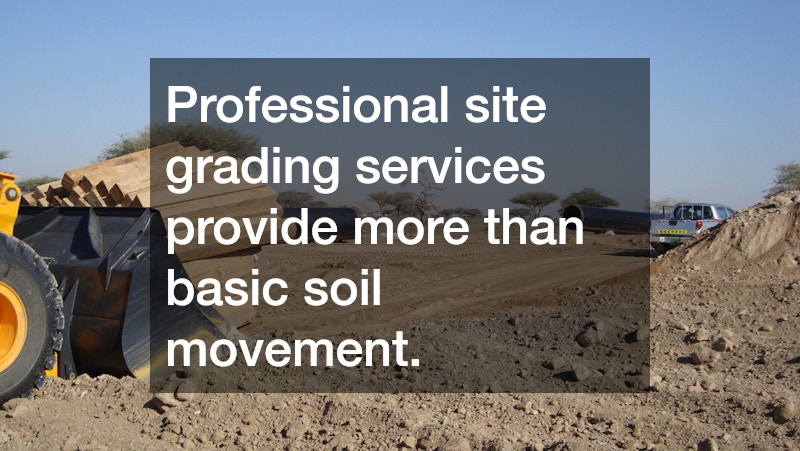
After developing a grading plan, professionals determine the equipment, materials, and earthwork processes needed to complete the project. The scope can vary considerably depending on the size of the property, the amount of material that must be moved, accessibility, soil conditions, and the desired final elevations. A detailed assessment allows the work to be organized around the property’s actual conditions instead of relying on assumptions.
Site grading services can also help prepare land for subsequent construction or landscaping activities. Properly established elevations can provide a more suitable foundation for features such as building pads, driveways, patios, lawns, and drainage improvements. When grading is coordinated with the overall project plan, other contractors can work from clearly established elevations and site conditions.
Throughout the process, professionals may verify grades and elevations to confirm that the completed work matches the intended plan. This attention to detail is particularly important when grading needs to meet engineering specifications, drainage requirements, or construction plans. Small discrepancies can affect how water flows or how subsequent work fits together, making accurate measurements an important part of the process.
Professional site grading services provide more than basic soil movement. They involve evaluating terrain, drainage, soil, elevations, and project requirements to determine how a property should be prepared. By taking these factors into account before and during earthwork, property owners can create a more functional site that is ready for its intended improvements. A thorough grading assessment is therefore an important step toward managing drainage concerns and establishing suitable conditions for construction or landscaping.